Journal / 04.10.2026 / Money / 3 min
Pay the ADHD tax up front
Late fees, a renewal nobody canceled, food that went off in the fridge. The same money, spent on purpose beforehand, buys the structure that stops it.

The ADHD tax is the name people with ADHD give to the money that leaks out through executive function: the late fee on a bill you meant to pay, the subscription that renewed after the free trial, the return window that closed with the parcel still in the hall. It is rarely one large cost. It is a steady trickle of small ones, and because each arrives feeling like a private failure, it rarely gets counted.
A better idea has been circulating in ADHD communities for a while, and it inverts the problem: pay the tax up front. Spend deliberately, in advance, on whatever removes the friction, instead of paying the penalty afterward. Pre-cut vegetables that actually get eaten. A second charger in the room you actually sit in. The slightly pricier option that does not depend on remembering anything.
Most money advice trades money for effort
Mainstream budgeting assumes effort is free and money is scarce. Log every transaction, categorize it, reconcile at the end of the month, adjust the categories, repeat. For someone whose scarce resource is the ability to do a dull recurring task on time, that is the most expensive budget there is. It fails quietly around week three, and the failure costs more than the budget saved.
The up-front version asks for structure once, then very little attention after that.
A structure that runs without you
The version that comes up again and again, from people who have made it work, has three parts.
- 01Two checking accounts. Account A pays bills and nothing else. Account B is spending money.
- 02One automatic transfer every payday into Account A, set a little higher than the bills need.
- 03Every bill on autopay from Account A.
After that, the weekly job is to look at two balances. Account B is what you can spend. Account A should never shrink over a month, because it takes in slightly more than it pays out.
The float is the number that matters
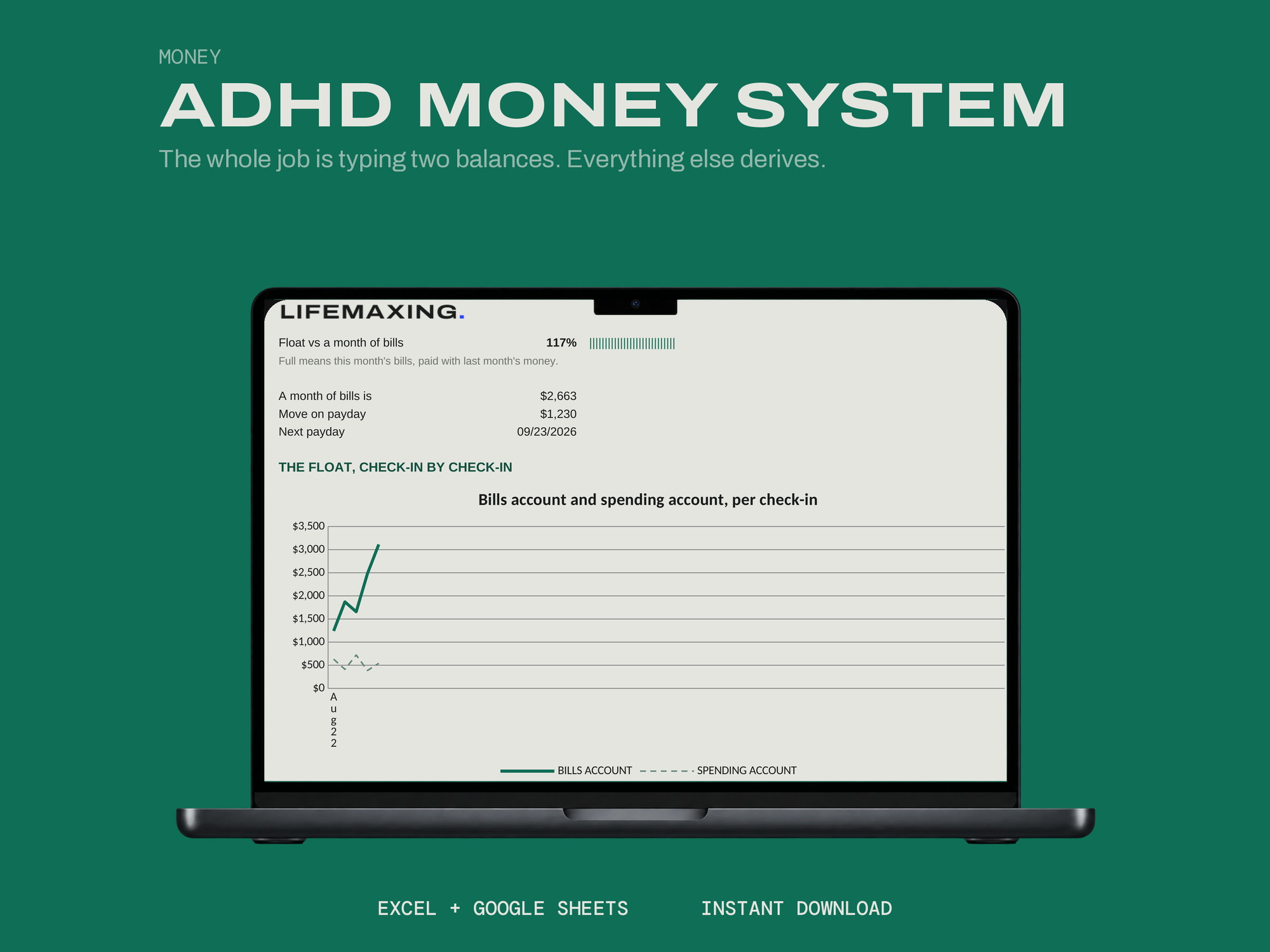
The extra you move each payday builds up in Account A. That surplus is the float, and it is the one figure worth watching. When the float equals a full month of bills, you are paying this month's bills with last month's money. A paycheck that lands three days late stops being an emergency. An autopay that fires before payday stops overdrawing anything.
Getting there is slow and asks for nothing. Fifty dollars over the bills on each biweekly paycheck adds up to $1,300 over a year, without a single decision after setup.
Count the tax you still pay
Some tax will still get paid. A late fee still happens; something still renews. The useful response is to write it down, what it was and what it cost, somewhere built for the purpose. Named and counted, it becomes a line item you can shrink. Left uncounted, it stays a source of shame, and shame is a poor budgeting method.
Build a system that works in the weeks you cannot, rather than waiting to become someone who never forgets.
What this looks like in a sheet
The ADHD Money System is this structure as a workbook. You list the bills once and it tells you what to move each payday, rounded up to the next five dollars so the rounding feeds the float. Each week you type the two balances from your banking app, and the Dashboard shows the float, how many weeks of bills it covers, and the best it has reached. An ADHD Tax tab keeps the toll counted. It does not connect to a bank or move any money; you set up the accounts and the transfer, and it does the arithmetic.
If you would rather start smaller, the free Starter Budget Sheet is a single page and takes about twenty minutes to fill in.
Tools for Money
All Money →